According to waterfootprint.org, I use 1,083 cubic meters of water in one year. This is significantly less than the national average for the United States, which is 2,842 cubic meters per year. According to nationalgeographic.com, I use 1,660 gallons of water each day. The U.S. average is 2,088 gallons per day.
The global average water footprint is 1,385 cubic meters per person per year, less than half the average in the United States. In the U.S., 20.2% of the water footprint falls outside of the country. In the Middle East, specifically in the Arabian Peninsula, the percentage of the water footprint falling outside of the states is much higher. In Yemen, 75.7% of the footprint falls outside; in the United Arab Emirates, 75.7% falls outside; in Saudi Arabia, 66.1% falls outside.
There are many implications that go along with having such large percentages of these water footprints falling outside of the states. This is an indication of the dependence on outside sources of water, food, and other goods that require large quantities of water to produce. Similar to the United States’ dependence on foreign oil, states in the Middle East are dependent on foreign water. This is a human rights issue, as well as an issue of economics and politics.
The average water footprint of an individual in Yemen is 901 cubic meters, while the average water footprint of someone in the United Arab Emirates is a whopping 3,136 cubic meters (more than twice the global average). Both have the same percentage of their footprint falling outside of the country. This disparity may be caused by the oil wealth enjoyed by the UAE and lacked by Yemen. People in poorer countries do not have the same access to fresh water as those in wealthier countries, which is a major reason for the water footprint being so much smaller.
States with larger percentages of their water footprints falling outside the country are subject to market fluctuations, potentially subjecting their economies to stress when food prices rise. States with smaller percentages of their water footprints falling outside the country are more self-sufficient and are not as subject to market fluctuations. Those countries that rely heavily on outside sources for water, food, and other goods are more interdependent, which is a bad thing from a realist’s perspective. According to liberalism, however, this interdependence is positive and fosters stability.
Monday, October 13, 2014
Thursday, September 25, 2014
Tuesday, September 16, 2014
The"Others" in Our Communities
In any community, however large or small, there are social divides. These can be based on things such as race, age, gender, political affiliation, and religion; however they can also be based on groups such as fraternities and sororities, sports teams, and other clubs that one might find on a college campus. The culture at Dickinson College is fairly segmented into an “us and them” relationship. The different social organizations on campus can be very exclusive and there are even sharp tensions between different social groups, sometimes even leading to physical violence between members of the different groups. Evidence of the divisions between certain groups on campus can be seen scrawled on the desks and walls in graffiti, and can be overheard at social gatherings or in passing on the quad. The origins of these divisions are unclear, however there is now a culture on this campus of otherness.
Being a member of the Greek system, an “other” to me might generically be anyone who is unaffiliated. Someone who is unaffiliated may look at Greeks as others. There is a strong sense of otherness even within the Greek system, however, and there are rivalries between different organizations within the Greek system. These rivalries are the result of competition, just as sports teams have rivalries. Otherness is everywhere.
There have been efforts by the administration to break down these barriers by waging a war on Greek life and encouraging students to diversify their Dickinson experience, however it is unclear whether this has actually improved anything. There is still a very strong sense of otherness, regardless of the perspective one may take.
Tuesday, September 9, 2014
Understanding the Middle East
The circumstances under which a person grows up act as a frame or a lens through which that person may view the world. This is true of people who grow up and live in the United States and other parts of the West, as well as of people who grow up and live in the Middle East. Growing up and living in the United States provides people with a very slanted view of the Middle East, and without further investigation, a person living in the United States might never really understand the Middle East. The same is true for people living in the Middle East. The United States is portrayed and viewed a certain way in other countries, based on actions taken by the United States, its relations with other states, and its policies.
The cultures of the United States and of the Middle East are fundamentally different, and inevitably misunderstand each other. The culture of the United States is an amalgam of different cultures that have mixed together over the course of its history, and different regions within the United States have their own subcultures. The culture of the Middle East can be described similarly; there are many cultures spread across the different states and nations that are contained in the Middle East. Regardless of the region, however, the culture with which a person grows up shapes his or her view of the world.
In order to overcome these barriers and better understand each side of this, one must look beyond domestic sources of information. Getting news and information from a variety of sources rather than just one or a few is a good way to begin to overcome these barriers. Considering outside points of view with an open mind and attempting to look at issues from different angles are also good ways to try and understand other cultures and people more fully. Looking at foreign news sources, actually speaking with people from the Middle East, and traveling to the region are all excellent ways to overcome barriers and better understand.
Thursday, May 1, 2014
Freedom, or Lack Thereof, in Bahrain
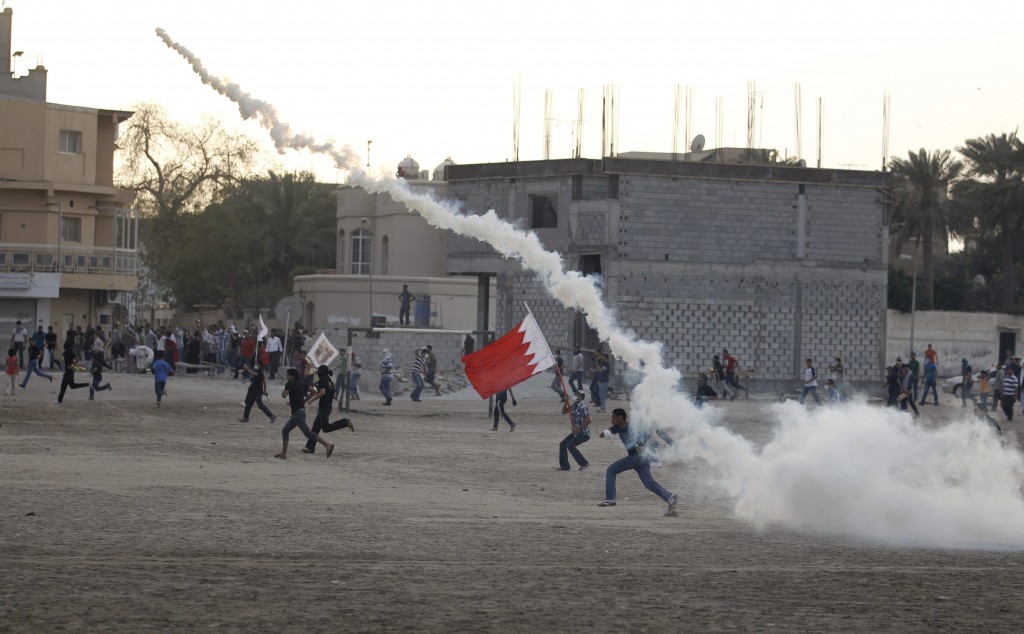
Bahrain has experienced sustained political and social unrest in the past several years, as a result of the Arab Spring and longstanding injustices instituted by the royal family. The population has a Shi’ite Muslim majority, however the country is ruled by the Sunni royal family, which influences who is represented in government. Shi’as are vastly underrepresented.
Political demonstrations are illegal in Bahrain, and are regularly met with brutal crackdowns by state police forces. Thousands of people have been arrested for demonstrating against the state, and detainees may be subject to torture of various kinds. These brutal responses by police only strengthen dissenters’ resolve, and demonstrations continue to gain strength.
Demonstrators themselves are not the only ones subject to arrest, exile, intimidation and torture. “The arrests also extended to journalists and bloggers who reported on the crackdown, and medical personnel who treated injured protesters. Thousands of people were fired from their jobs for supporting the uprising.” Organizers of human rights NGOs are often arrested and set up with fabricated charges, resulting in either lengthy prison sentences or exile.
Media ownership in Bahrain is far from an ideal situation, and the state owns all broadcast media. What few private newspapers exist are owned by businessmen close to the royal family. The government has a great deal of control over what is printed and broadcast, not only censoring unfavorable stories but fabricating and shaping news reports to cast a positive light on the regime and a negative one on human rights organizations and other NGOs. “Self-censorship is encouraged by the vaguely worded 2002 Press Law, which allows the state to imprison journalists for criticizing the king or Islam, or for threatening ‘national security.’”
The state blocks certain websites that it finds to be unfavorable, and has sentenced bloggers and other journalists in absentia for crimes against the state. The 2002 Press Law is vaguely worded and allows for a wide breadth of interpretation, allowing it to be applied to virtually any situation the king deems appropriate. Access to the country by foreign news media has also been restricted, with individual journalists being blocked from entering the country. Other journalists who have been allowed to enter the country have been arrested and deported for reporting on events contrary to the royal family’s wishes.
The King has total control over the judiciary, and virtually all other aspects of government. All laws are drafted by the king’s cabinet members, who are appointed by him, such that the king has control over what laws are written, how they are written, how they are implemented, and how they are enforced. Women are also vastly underrepresented in government and are generally not subject to the same protection under the law as men. Bahrain has scored a rating of “Not Free” by Freedom House, and ranks 53 out of 176 countries surveyed in Transparency International’s 2012 Corruption Perceptions Index.
source
Wednesday, April 30, 2014
Pakistan: Journalists under fire
“New report finds almost no one is punished for the daily threats and deadly attacks faced by journalists in Pakistan.”
Pakistan has seen the deaths of at least 44 journalists as a result of their work in the past decade, and four journalists have been killed so far this year. Pakistan has long been ranked one of the most dangerous places in the world for journalists, and little is being done to change this. Reporters Without Borders “ranked Pakistan 158th out of 180 countries on its World Press Freedom Index this year - placing it below several countries considered to be active conflict zones, including Afghanistan (128th) and Iraq (153rd).”
Threats to journalists in Pakistan come from all sides–state intelligence agencies, police, military, sectarian groups, and religious extremist groups. The demands of these groups often contradict each other, placing journalists in a difficult situation. Journalists are coerced to shape their reporting based on the demands of these groups at the threat of violence, yet it becomes impossible for journalists to comply with all these demands at once. "Many are stuck in a situation where taking one perspective almost necessarily puts them at risk of incurring the wrath of another actor. So a lot of journalists are stuck in this almost impossible situation where catering to one perpetrator to avoid risk of abuse almost inevitably increases the risk of abuse from another perpetrator."
Threats and acts of violence against journalists go almost entirely unpunished in Pakistan, and there have been just two convictions in the murders of journalists in the past two decades. There is no mechanism or incentive to stop the human rights abuses and intimidation that is going on here, because people are literally getting away with murder. There is almost perfect impunity for crimes against journalists in Pakistan.
Any attempt by news outlets to expose or remedy the attacks on journalists are dealt with harshly, as was the case when a journalist for Geo, a television station, was attacked by gunmen and badly injured. The television station aired reports that accused the ISI (Inter-Services Intelligence) of the attacks on its journalist. The station received backlash from other news stations, which accused it of producing anti-state propaganda, as well as from the state, which moved to revoke Geo’s broadcasting license as a result of the accusations aired by the station.
As a result of the constant threat of violence against journalists, self-censorship runs rampant in broadcasting agencies “If the state doesn't like you, they eliminate you. If non-state actors don't like you, they just eliminate you."
Source
Tuesday, April 22, 2014
The Balance of Controls and Freedoms in Media
There are many strategies that regimes implement to oppress media freedoms, including threats of violence and imprisonment, state media ownership, bribery, censors, and vague laws interpreted on a case-by-case basis. Since the Arab Spring, many states in the Middle East and North Africa have seen improved freedoms for the media. Before the wave of uprisings, states such as Tunisia and Egypt both had strict laws and practices keeping media under the states’ control.
Tunisian media until 2003 was virtually entirely state-owned; licenses for television and radio stations were cautiously issued to people close to the regime who could be trusted to manage the content of their stations appropriately. In addition to the predominantly state-owned media, no foreign media were allowed into the country, with the exception of one French outlet. The media was tailored to show only positive views of the country and of its leader, essentially making them propaganda factories. Uprisings and other negative events in the country were largely ignored by the media. Social and labor unrest began to be prevalent in the country, at which point Ben Ali began to relax regulations and allow journalists and netizens more freedom. This move was seen as a sign of weakness and Ben Ali was eventually forced to flee the country in early 2011. The new constitution of Tunisia is actually quite progressive by international standards and most media is privatized, diverse and very lightly regulated.
In Mubarak’s Egypt, media freedom was very limited. There was a censor located at each individual media outlet, and owning one’s own newspaper was very difficult. Only people who were relatively close to the regime who could be trusted to manage content were given licenses to own newspapers or broadcast stations. State owned media and media closely controlled by the government covered only stories that would reflect positively on the regime, or at least not negatively. These regulations and censors were generally not very effective in Egypt, however, because the public had good access to international media. Most of the regime’s efforts to control the media fell flat because people were able to access international media as well as utilize social media for organizational purposes. Mubarak, like Ben Ali, was ousted after months of social unrest and demonstrations.
In contrast to these two states whose leaders have been ousted from power after years of oppression and non-existent media freedom, Lebanon is an example of a good balance of control and freedom. There has not been a major uprising in Lebanon in recent years, and the state was largely unaffected by the Arab Spring. Most media in Lebanon is privately owned, and is quite diverse. Media ownership is primarily reserved for powerful businessmen and other elites, but is not controlled for content by the government. There is enough media freedom in Lebanon that journalists and citizens have not been motivated to stage an uprising, yet the government still exercises a certain amount of control over the media. The 1994 Media Law places strict taxes and fees on media outlets, and there is a state agency that censors all incoming foreign media for religious and other controversial content. It is also illegal to slander religion or the president, however most other topics are fairly open. Lebanon has exercised an ample amount of control over its media such that it will be successful in maintaining the status quo, and the president will survive and remain in power.
Subscribe to:
Posts (Atom)